Background
Heidelberg Student Life
From the student prison to the fraternities, from the Schnookeloch to the Untere Strasse - how studying in Heidelberg has worked for 600 years.
The Karzer: detention as a status symbol
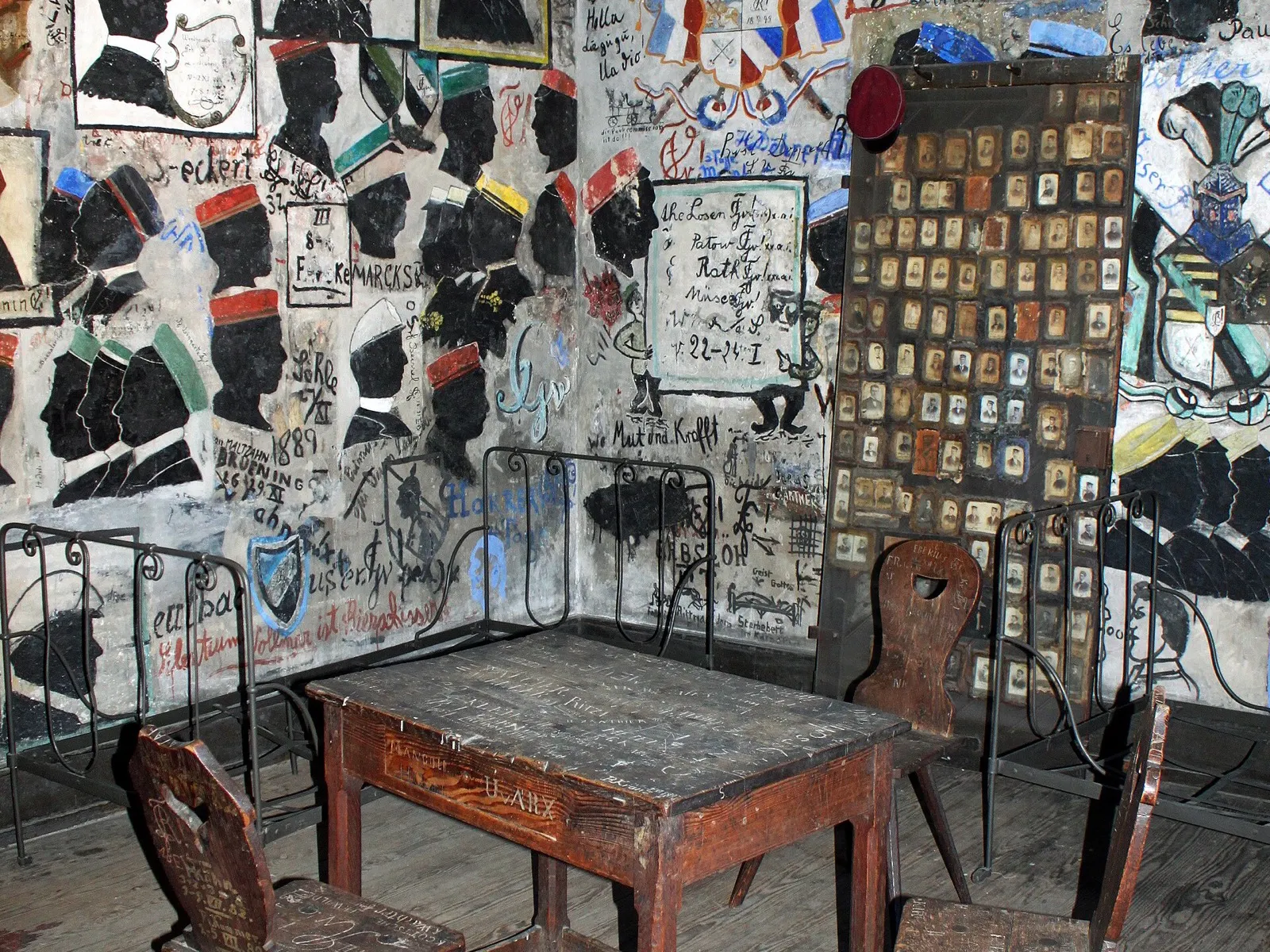
Until 1914 Heidelberg students answered to their university rather than to the town police. Anyone caught brawling or making a racket at night was locked in the Karzer in Augustinergasse for days or weeks - attending lectures was expressly permitted.
The punishment turned into a ritual. Inmates covered the walls with names, coats of arms and silhouettes of themselves, layer upon layer. Those walls are the reason the Karzer can be visited today: it is less a prison than a century-long guest book.
Fraternities and their long shadow
In the 19th century student corporations, their colours and the academic fencing bout defined the image of the Heidelberg student so strongly that it still works as a cliché abroad, carried by the play Alt-Heidelberg and its film versions.
In numbers little of it remains: the vast majority of the roughly 28,000 students have nothing to do with fraternities, even though their houses on the hillside are hard to miss.
Where people study and go out today
Studying happens at the university library on Universitätsplatz and in the Neuenheimer Feld; living happens in Bergheim, the Weststadt or Rohrbach, because the Old Town is barely affordable.
Going out still means the Untere Strasse, with an unusual density of bars in a few hundred metres. Historic addresses like the Schnookeloch survive, but are now more tourist destination than student local.